Dr Anna K. Döring contributed to a special Issue on ‘Research on Value Development in the School Context: New Directions and Approaches from an International Perspective’ in European Journal of Psychology of Education.
Overview
Human values are at the core of educational frameworks worldwide, providing a framework within which learning in primary and secondary school occurs. However, very few empirical studies had researched how children’s and adolescents’ values take shape and develop in the school context. This special issue helps fill this gap by publishing findings on how factors in the classroom (e.g., peers’ behaviour, classroom teachers’ educational goals), in the school (e.g., school climate, school vision), and the wider societal context shape children’s and adolescents’ values and how in turn their values may affect their behaviour, choices, and wellbeing.
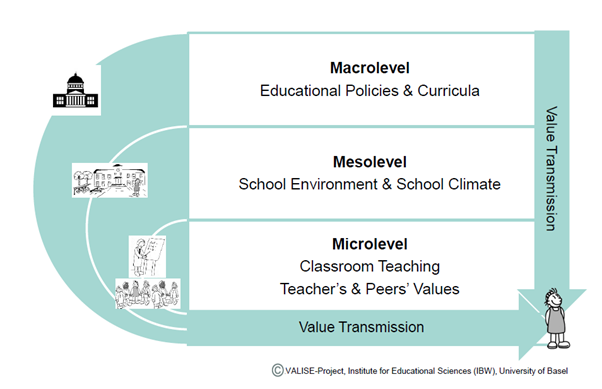
This special issue introduces and applies the Value Transmission in the School Context model, which explains how children’s and adolescents’ values are shaped at the micro-, meso-, and macro-level, looking at teaching in the classroom, the values of classroom teachers and classmates, the school environment and school climate, and educational policies and curricula. The ten original studies in this issue present data from six countries across preschool, primary school and secondary school and highlight the dynamic interplay between vertical value transmission (from educational systems to classroom practices and vice versa) and horizontal transmission (between teachers and students, as well as among peers).
Why is this issue important?
This special issue advances the study of value formation in educational settings by introducing and applying the Value Transmission in the School Context model. The special issue includes an editorial and ten empirical articles, spanning multiple cultural and national contexts, including Switzerland, Poland, Italy, Israel, and the UK.
Papers included in special issue
1. Elizarov et al. (2024): Personal values and social behavior in early childhood: Understanding the contribution of social information processing and attitudes
2. Scholz-Kuhn et al. (2025): Children’s personal values and their behavior in the classroom in the early elementary school years: mapping longitudinal trajectories
3. Collins et al. (2024): Personal values, subjective wellbeing, and the effects of perceived social support in childhood: A pre-registered study
4. Cieciuch et al. (2024): Peers and value preferences among adolescents in school classes: a social network and longitudinal approach
5. Russo et al. (2023): A web-based prosocial intervention can shape adolescents’ values: findings from a mixed-methods study
6. Segal et al. (2025): Values and educational decisions: How do values relate to adolescents’ academic track choices?
7. Vaknin & Schachter (2024): School-home identity fit, school climate, and student identification with religious values: The case of students from Masorti and Orthodox homes in Israeli religious high schools
8. Oeschger et al (2024): The interplay between teachers’ value-related educational goals and their value-related school climate over time
9. Döring et al. (2024): Giving voice to educators: Primary school teachers explain how they promote values to their pupils
10. Daniel et al. (2024): The values of schools: an analysis of vision statements